ETIAS 2026: Do You Need a Passport Photo for Europe?
By Elena Dev, Founder · May 21, 2026 · 7 min read
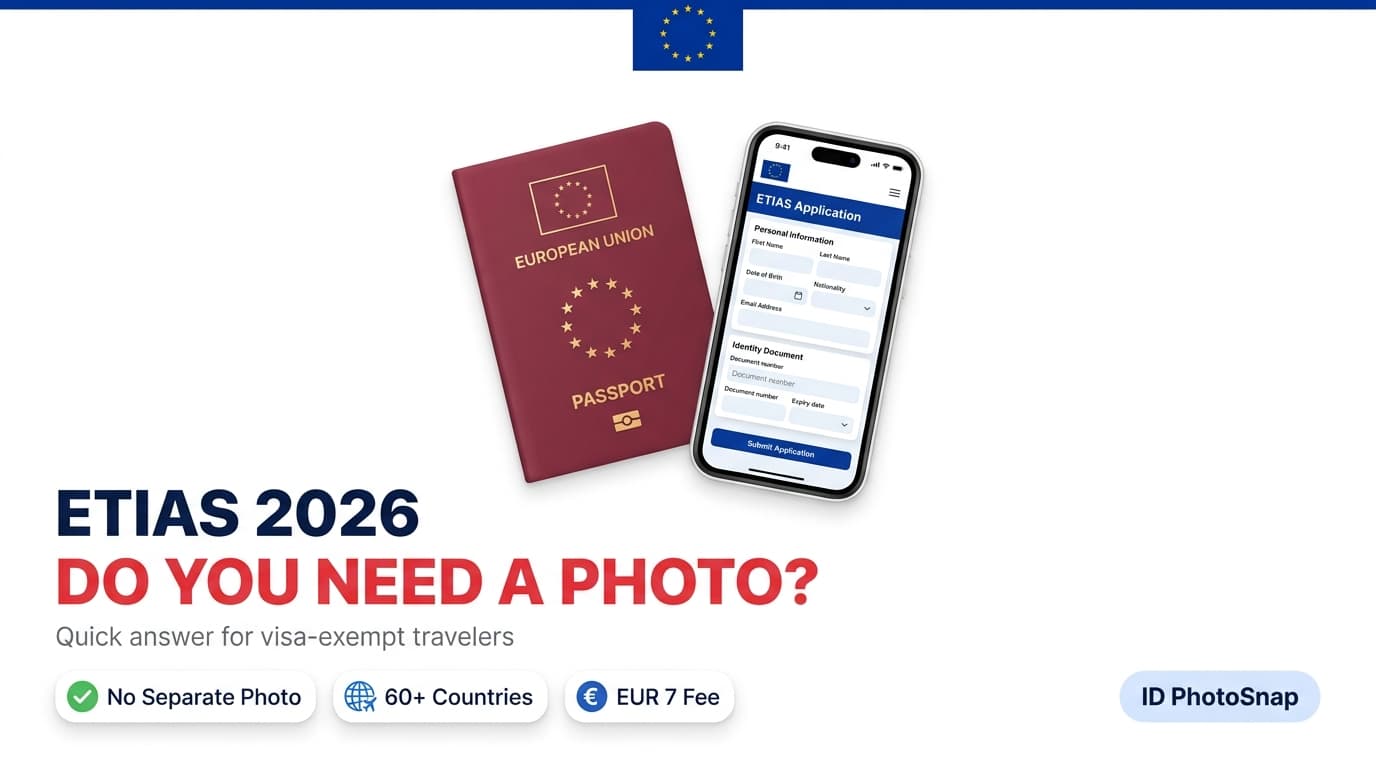
ETIAS does not require a passport photo. Europe’s new travel authorisation, launching in late 2026, is an online form tied to your existing passport, there is no separate photo upload. The most common question travellers ask as ETIAS approaches is whether they need to prepare a photo. Here is the clear answer, and what actually does change for travel to Europe.
The short answer
ETIAS (European Travel Information and Authorisation System) is a pre-travel authorisation, not a visa and not a photo submission. You fill in an online form with your passport details, personal information, and trip plans. The system checks you against security databases and issues an authorisation linked to your passport. No photo file is uploaded at any point.
The only photo that matters for ETIAS is the one already printed in your passport, and that photo had to meet your country’s passport standard when the passport was issued. If your passport is current and valid, you have nothing to prepare photo-wise for ETIAS itself.
ETIAS, EES, two different things
Travellers conflate the two new EU systems. They are separate:
- EES (Entry/Exit System), fully operational since 10 April 2026. It is a border system. When you arrive in the Schengen Area, EES records your fingerprints and a live facial image at the border, replacing the manual passport stamp. You do not upload anything, the facial image is taken on the spot by border equipment.
- ETIAS (European Travel Information and Authorisation System), launching late 2026. It is an advance online authorisation, similar to the US ESTA or the UK ETA. You apply before you fly. It uses only your passport data, no biometrics, no photo upload.
So across both systems: EES takes your facial image live at the border, and ETIAS takes no image at all. Neither asks you to prepare or upload a passport photo.
Who needs ETIAS, and who does not
ETIAS applies to citizens of roughly 60 visa-exempt countries travelling to the Schengen Area for short stays (up to 90 days in any 180-day period). This includes the United States, United Kingdom, Canada, Australia, New Zealand, Japan, South Korea, Brazil, and many others.
Who does not use ETIAS: travellers who already need a full Schengen visa , applicants from India, Nigeria, Pakistan, Indonesia, Vietnam, Bangladesh, China, and most of Africa and South Asia. For these travellers nothing changes: they continue to apply for a Schengen visa, and that does require a 35×45 mm photo with a light grey or white background submitted at a VFS Global or TLScontact centre.
Cost, validity, and timing
- Cost: expected around EUR 7 per application for travellers aged 18 to 70. Under 18 and over 70 are expected to be fee-exempt.
- Validity: 3 years, or until the passport expires, whichever comes first. Multiple short trips are allowed within that window.
- Launch: last quarter of 2026, with a transitional grace period afterward. Applications are not open yet, be cautious of any site claiming to take ETIAS applications now.
Where a passport photo still comes in
ETIAS is tied to your passport, so an indirect requirement exists: your passport must be valid for the whole ETIAS period you want to use. If your passport is close to expiry, you will renew it before travelling, and a passport renewal does need a compliant photo.
For most countries that is a 35×45 mm photo with the correct background (white for most, light grey or cream for the UK, light grey or white for Germany and several Schengen states). US and Indian passports use the 51×51 mm square format. You can produce a compliant passport-renewal photo for any of 100+ countries with the free IDPhotoSnap tool, browser-only, no upload, no watermark.
Frequently asked questions
Does ETIAS require a passport photo?
No. ETIAS does not require you to upload a separate passport photo. ETIAS is an online travel authorisation tied to your existing biometric passport, you complete a web or app form with passport details, personal information, and travel plans. The only photo that matters is the one already in your passport, which must itself meet your country’s passport photo standard (typically 35×45 mm for most countries, 51×51 mm for the US and India).
When does ETIAS launch?
ETIAS (European Travel Information and Authorisation System) is scheduled to launch in the last quarter of 2026. An exact date has not been confirmed and applications are not yet open. There will be a transitional grace period after launch during which travel without ETIAS is still tolerated. ETIAS launch follows the EU Entry/Exit System (EES), which became fully operational on 10 April 2026.
Who needs ETIAS?
ETIAS is required for citizens of roughly 60 visa-exempt countries when travelling to the Schengen Area for short stays, including the United States, United Kingdom, Canada, Australia, New Zealand, Japan, South Korea, Brazil, and others. Travellers who already need a full Schengen visa (applicants from India, Nigeria, Pakistan, Indonesia, Vietnam, Bangladesh, China, and most of Africa and South Asia) do NOT use ETIAS, they continue to apply for a Schengen visa, which does require a 35×45 mm photo.
What is the difference between ETIAS and EES?
EES (Entry/Exit System) is a border system: when you arrive in the Schengen Area, EES captures your fingerprints and a live facial image at the border kiosk or booth, replacing manual passport stamping. ETIAS is a pre-travel authorisation: you apply online before you fly. EES captures biometrics at the border; ETIAS is an advance form. Neither requires you to upload a photo file, EES takes your facial image live at the border, and ETIAS uses only your passport data.
How much does ETIAS cost and how long is it valid?
ETIAS is expected to cost around EUR 7 per application for travellers aged 18 to 70 (applicants under 18 or over 70 are expected to be exempt from the fee). A granted ETIAS is valid for 3 years, or until the passport expires, whichever comes first, and allows multiple short stays in the Schengen Area within that period.
Do I still need a compliant passport photo if ETIAS does not ask for one?
Yes. ETIAS is tied to your passport, so your passport must be valid and machine-readable. If your passport is expiring or you are applying for a new one before your trip, the new passport still needs a compliant photo, 35×45 mm with the correct background for most countries. ETIAS itself takes no photo, but a valid passport with a compliant photo is the prerequisite for ETIAS.
Related guides
Bulgaria Digital Nomad Visa 2026: How to Apply + Photo Spec
Bulgaria launched its Digital Nomad Visa in 2026. Who qualifies, what documents are needed, and the 35x45 mm Schengen photo spec.
EES Is Live: Do You Need a New Passport Photo? (April 2026 Update)
The EU's Entry/Exit System launched on April 10, 2026. Here's what actually changed for passport and visa photos - and what didn't. Schengen visa specs, EES border biometrics, and ETIAS in plain language.
5-Year Schengen Visa for Indians: Cascade Rule (2026 Guide)
The EU cascade rule lets Indians earn 2-year then 5-year multi-entry Schengen visas after 2 prior visas in 3 years. Photo: 35x45 mm.
UK ETA 2026: Full Enforcement, GBP 20 Fee, 84 Countries
UK ETA enforced from 25 Feb 2026 for 84+ countries. Fee raised to GBP 20 on 8 April. What changed for US, EU, Australia, India.
UK ETA: Do You Need a New Passport Photo? (2026 Guide)
The UK Electronic Travel Authorisation (ETA) is mandatory for most visa-exempt visitors. What needs a photo, what does not, and how.
Spain Digital Nomad Visa Photo 2026 (35x45 mm, Schengen)
Spain DNV photo spec: 35x45 mm Schengen, EUR 2,762/mo income. Notes for applicants from the US, UK, India, Russia, Latin America.
About the Author
Elena Dev, Founder of IDPhotoSnap
Elena Dev is the sole operator of IDPhotoSnap. Her work involves auditing the official photo specifications of 100+ countries against issuing-authority sources (embassies, government portals, ICAO 9303) and translating those rules into a browser-only tool that runs entirely on the user's device. The full 276-format specification dataset is published as MIT open data on GitHub. Source verification methodology and corrections policy are documented on the editorial standards page. Every article is written and reviewed by Elena Dev. Corrections: elena@idphotosnap.com.
Found this useful? Public reviews are how new readers discover IDPhotoSnap. Leave a quick Trustpilot review →
Renewing your passport before an ETIAS trip?
Make a compliant passport-renewal photo for 100+ countries. Free, browser-only, no upload, no watermark.
Open the passport photo tool →