EES Is Live: Do You Need a New Passport Photo? (April 2026 Update)
By Elena Dev, Founder · May 2, 2026 · 8 min read
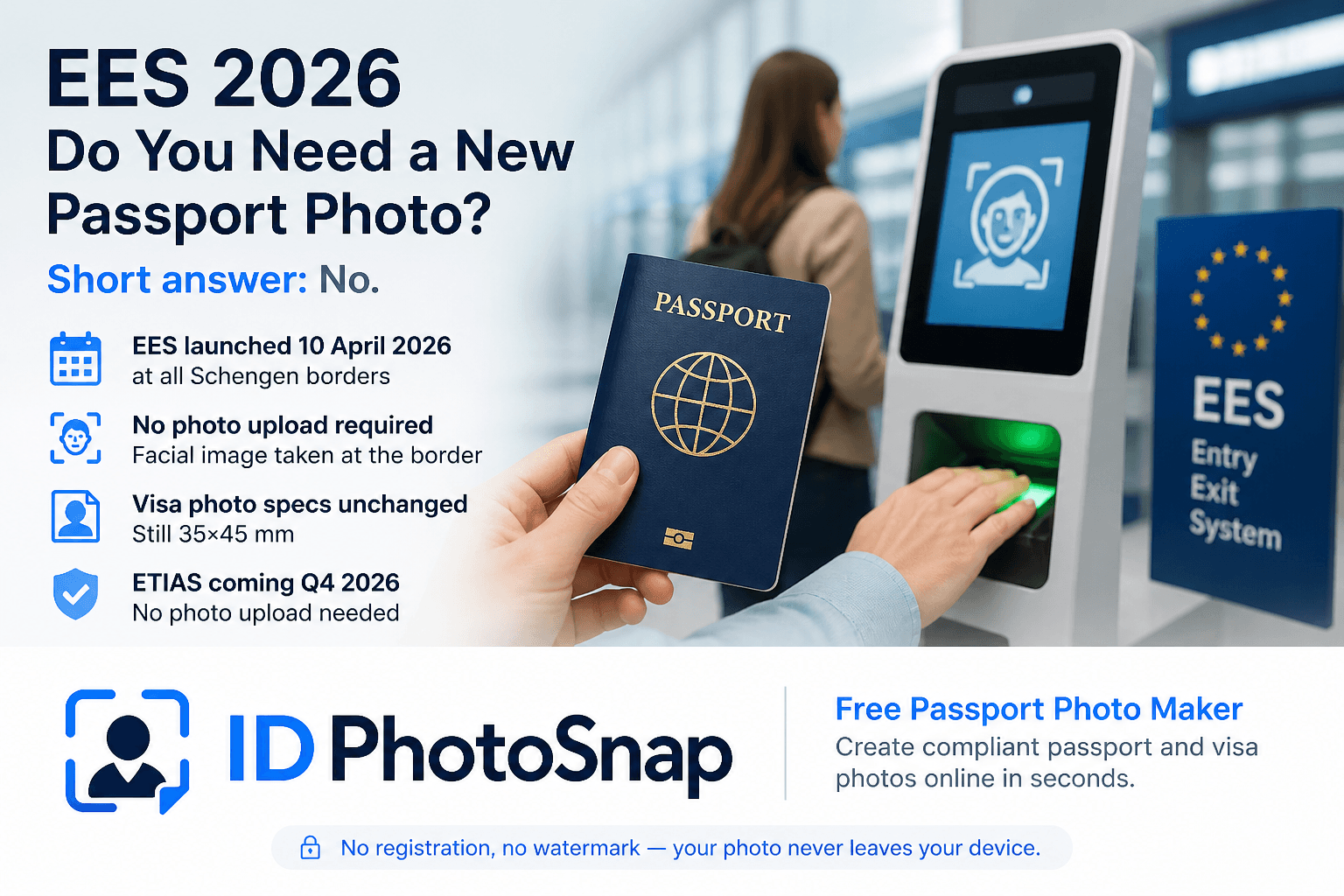
Since the EU's Entry/Exit System (EES) went live on 10 April 2026, the same question keeps showing up in travel forums: do I need a new passport photo because of EES? Short answer - no. Long answer - the rules around Schengen visa photoshave not changed at all, but the confusion is understandable. Here is exactly what changed, what didn't, and what you actually need to bring.
The short version
- EES launched 10 April 2026 at all Schengen border checkpoints.
- You do not need to upload or bring a new photo for EES. The facial image is taken at the border on first entry.
- Schengen visa photo specs (35×45 mm) are unchanged. If you are applying for a visa, the photo requirement is exactly what it was in 2025.
- ETIAS is coming in Q4 2026 - no photo upload required for that either, based on official guidance.
- The only thing that has changed at the border itself: an extra 30-90 seconds for biometric capture on first entry.
What is EES, exactly?
The Entry/Exit System is an automated IT system that registers non-EU travellers each time they cross the external Schengen border. It replaces the manual passport stamp with a digital record. The system stores:
- Your name, date of birth, and travel-document data
- The date and place of entry and exit
- Four fingerprints
- A facial image for biometric matching
EES applies to short-stay travellers (up to 90 days in any 180-day period) who do not hold an EU/EFTA passport, residence permit, or long-stay visa. So: most US, UK, Canadian, Australian, Indian, Brazilian, and other third-country nationals, whether visa-required or visa-exempt.
Where the photo confusion comes from
Three things got mashed together in the public conversation around EES, and the result is a wave of "do I need a new photo" questions:
- The Schengen visa photo - a 35×45 mm photograph submitted with a visa application. This has existed for years and the spec is unchanged.
- The EES facial image - captured at the border by an officer or kiosk on first entry. You do not provide this, the system takes it.
- The ETIAS authorisation- a separate online system launching in Q4 2026 for travellers who don't need a Schengen visa. Based on official guidance, it does not require a photo upload.
Travel agents, immigration consultants, and embassy front desks have not always been clear in distinguishing these three, and that's where the "new EES photo" misconception spread.
What still requires a photo (and the spec)
If you need a Schengen visa to enter - that is, you hold a passport that is not on the visa-free list (Indian, Pakistani, Egyptian, Nigerian, Chinese, Russian, and many others) - your visa application still requires a printed or digital passport-style photograph. The specification:
Schengen visa photo (unchanged in 2026)
- Size: 35×45 mm
- Face occupies 70-80% of the frame (chin to crown 32-36 mm)
- Background: light grey or off-white, even and shadowless
- Expression: neutral, mouth closed
- Eyes: open, looking at the camera, no glasses
- Taken within the last 6 months
- Print on photo paper or upload as JPEG (depends on consulate)
See the full Schengen visa photo guide for size templates, common rejections, and a free tool that crops to the exact dimensions in your browser.
What happens at the EES border on first entry
On your first crossing into the Schengen Area after 10 April 2026, expect this sequence at the border:
- An officer or self-service kiosk scans your passport.
- You place four fingers (typically right hand) on a fingerprint scanner.
- A camera takes a live facial image - looking straight at the lens, neutral expression. No need to remove your glasses for this; the algorithm handles it.
- The system creates your EES record with a 3-year retention period.
- You proceed through the border check.
Total time: roughly 1-3 minutes per traveller for first registration. After that, repeat entries within 3 years use a self-service kiosk and take 30-60 seconds.
Children, fingerprints, and exemptions
- Children under 12: facial image is taken, fingerprints are not.
- EU/EFTA citizens: exempt entirely - no EES record, no biometric capture.
- Long-stay visa or residence permit holders: exempt for the duration of the permit.
- Diplomats with diplomatic visa: exempt under standard diplomatic rules.
- People physically unable to provide fingerprints: facial image only.
Which countries use EES?
All 29 Schengen states - the EU members participating in Schengen plus the four associated countries:
- EU Schengen members: Austria, Belgium, Bulgaria, Croatia, Czechia, Denmark, Estonia, Finland, France, Germany, Greece, Hungary, Italy, Latvia, Lithuania, Luxembourg, Malta, Netherlands, Poland, Portugal, Romania, Slovakia, Slovenia, Spain, Sweden.
- Non-EU Schengen associates: Iceland, Liechtenstein, Norway, Switzerland.
Ireland and Cyprus do not participate in EES. Crossing from Ireland to France, however, counts as a Schengen entry and triggers EES at the French border.
EES vs ETIAS - what's the difference?
| Aspect | EES | ETIAS |
|---|---|---|
| Status | Live since 10 April 2026 | Launches Q4 2026 |
| What it is | Border biometric register | Pre-travel authorisation |
| Who needs it | All non-EU short-stay travellers | Visa-exempt nationals only (US, UK, Canada, etc) |
| Photo upload? | No - taken at border | No - passport details only |
| Cost | Free | €7 (under-18 and over-70 free) |
| Where | Border | Online before travel |
Practical advice for travel in 2026
- If you need a Schengen visa: get the standard 35×45 mm photo. Nothing has changed about the spec. The free Schengen visa photo tool crops any photo to the exact dimensions in your browser.
- If you're visa-exempt (US, UK, Canada, etc): wait for ETIAS to open in Q4 2026, then apply online. No photo needed.
- Arriving at a Schengen border in 2026:budget an extra 5-15 minutes at passport control during peak hours, especially during the rollout months. Bring kids' passports and have them ready for face capture.
- Don't fall for "EES photo packages" from third-party services.There is no such thing. EES does not accept uploaded photos.
FAQ
Do I need a new passport photo because of EES?
No. EES does not require you to upload or bring a new photo. The facial image is captured at the border on first entry by an officer or self-service kiosk.
Does my Schengen visa application still need a photo?
Yes. The visa photo specification (35×45 mm, 70-80% face coverage, neutral background) is unchanged. EES is a separate system that runs after the visa is already issued.
Will ETIAS require a photo upload?
Based on official guidance for Q4 2026, the ETIAS online application does not require a photo upload - only passport details, travel info, and a €7 fee.
Which countries use EES?
All 29 Schengen states. Ireland and Cyprus do not participate.
What if I lose weight, change my hair, or get older?
The matching algorithm tolerates minor changes. EES records expire after 3 years and a new image is captured on next entry. No proactive update needed.
Do children need a photo for EES?
Yes - a facial image is taken at the border. Children under 12 are exempt from fingerprints but not from face capture.
Why are travel agents still asking for photos?
They are asking for the standard visa application photo, not an EES photo. The two are different. The visa photo is required to issue the visa sticker before travel.
Need a Schengen visa photo for an upcoming application? Crop yours to the exact 35×45 mm spec for free - runs in your browser, no upload, no signup.
Related guides
Bulgaria Digital Nomad Visa 2026: How to Apply + Photo Spec
Bulgaria launched its Digital Nomad Visa in 2026. Who qualifies, what documents are needed, and the 35x45 mm Schengen photo spec.
5-Year Schengen Visa for Indians: Cascade Rule (2026 Guide)
The EU cascade rule lets Indians earn 2-year then 5-year multi-entry Schengen visas after 2 prior visas in 3 years. Photo: 35x45 mm.
ETIAS 2026: Do You Need a Passport Photo for Europe?
ETIAS launches late 2026 for visitors from 60+ visa-exempt countries. Short answer: no separate photo upload. What it does need.
UK ETA 2026: Full Enforcement, GBP 20 Fee, 84 Countries
UK ETA enforced from 25 Feb 2026 for 84+ countries. Fee raised to GBP 20 on 8 April. What changed for US, EU, Australia, India.
UK ETA: Do You Need a New Passport Photo? (2026 Guide)
The UK Electronic Travel Authorisation (ETA) is mandatory for most visa-exempt visitors. What needs a photo, what does not, and how.
Italian Passport Photo Requirements 2026 (Polizia di Stato)
Italian passport photo specs 2026: 35x45 mm, plain white background, ICAO 9303 biometric compliance, Polizia di Stato standards.
German Schengen Visa Photo 2026 (35x45 mm, Embassy)
2026 photo specs for German Schengen, work, and student visas, plus the May 2025 Buergeramt digital-only rule affecting citizens.
China Visa Photo 2026 (33x48mm, COVA + Consulate Compliant)
33x48 mm Chinese visa photo, COVA-ready and consulate-compliant. White background, ICAO biometric specs, JPG + printable PDF. Free.
Spain Digital Nomad Visa Photo 2026 (35x45 mm, Schengen)
Spain DNV photo spec: 35x45 mm Schengen, EUR 2,762/mo income. Notes for applicants from the US, UK, India, Russia, Latin America.
About the Author
Elena Dev, Founder of IDPhotoSnap
Elena Dev is the sole operator of IDPhotoSnap. Her work involves auditing the official photo specifications of 100+ countries against issuing-authority sources (embassies, government portals, ICAO 9303) and translating those rules into a browser-only tool that runs entirely on the user's device. The full 276-format specification dataset is published as MIT open data on GitHub. Source verification methodology and corrections policy are documented on the editorial standards page. Every article is written and reviewed by Elena Dev. Corrections: elena@idphotosnap.com.
Found this useful? Public reviews are how new readers discover IDPhotoSnap. Leave a quick Trustpilot review →