German Schengen Visa Photo 2026 (35x45 mm, Embassy)
By Elena Dev, Founder · May 3, 2026 · 9 min read
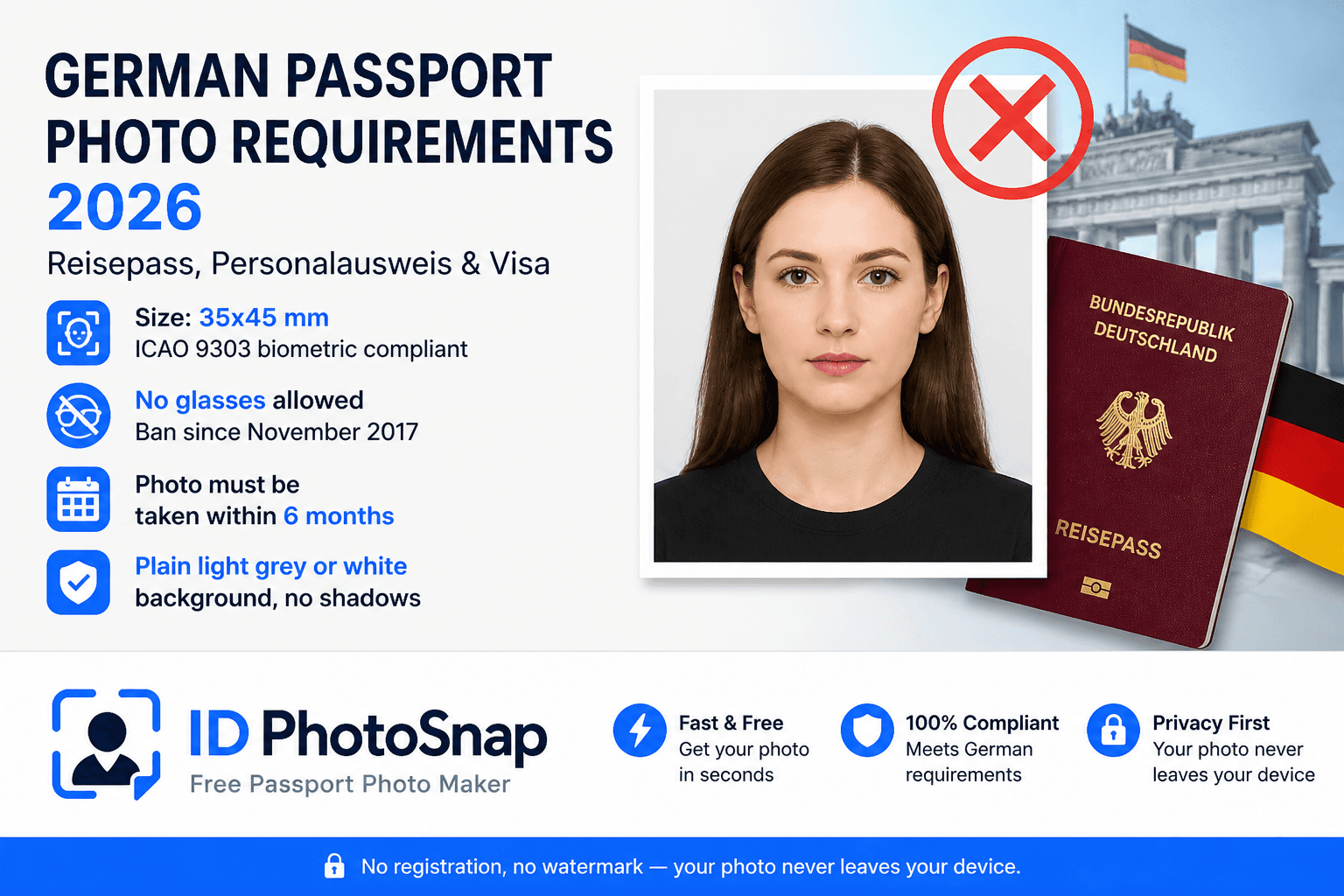
Germany has some of the strictest photo standards in Europe. The Auswaertiges Amt (Federal Foreign Office), Bundesdruckerei, and German consulates abroad follow ICAO 9303 biometric standards plus a few additional German requirements. This guide covers what is required for a German Schengen visa, work visa, student visa, residence permit (Aufenthaltstitel), and Personalausweis - with the most useful detail for non-EU applicants applying through a German embassy or consulate abroad.
Important update: Germany switched to digital-only photos for German citizens (May 2025)
Since 1 May 2025, German citizens applying for a Reisepass or Personalausweis renewal at a Buergeramt can no longer submit paper photos. They must use the Buergeramt self-service terminal (~6 EUR) or visit a certified Fotograf who uploads the photo to the e-passport system and gives a QR code. The transition period ended 31 July 2025.
This rule applies only to German citizens renewing German ID documents at a Buergeramt. If you are a non-EU national applying for a German Schengen visa, work visa, student visa, or residence permit through a German embassy or consulate abroad, the standard 35x45 mm digital photo specifications still apply and you can prepare it yourself or have a photographer do it.
Quick summary (visa applicants)
- Size: 35x45 mm (3.5x4.5 cm)
- Background: plain light grey or white, no patterns, no shadows
- Face height: 32-36 mm from chin to crown (70-80% of frame)
- Expression: neutral, mouth closed, looking straight at camera
- Glasses: banned since November 2017, no exceptions for cosmetic reasons
- Age: photo must be taken within the last 6 months
- Format: ICAO 9303 biometric compliant
- Same 35x45 mm specs apply to Schengen visa, German work visa (Blue Card), student visa, family reunion visa, and residence permit applications
Why German specs are stricter than other EU countries
While the underlying ICAO standard is shared across the EU, Germany applies it more rigidly. The Bundesdruckerei produces all German passports and runs automated biometric quality checks that reject photos other EU member states would accept. Common reasons:
- The face position must be exactly centered, with the face vertical axis perpendicular to the camera. Even a 5-degree tilt is flagged.
- The background must be uniformly lit. Diagonal shadows from window light cause rejection even if the gradient is barely visible.
- Skin tone must be naturally rendered. Heavy color filters or beauty mode on phones causes rejection.
If you used a German passport photo at the Bundesdruckerei kiosk in 2024-2025 and it was rejected, the most likely reason is one of these three.
Detailed specifications
Size and dimensions
The German passport photo size is 35 millimeters wide by 45 millimeters tall. In pixels at 300 DPI, this is approximately 413 x 531 pixels. The face from chin to crown must occupy 32 to 36 millimeters of the vertical frame.
Background color
Light grey is the official Bundesdruckerei recommendation. Plain white is also accepted but tends to wash out skin tones in some printing. If choosing white, make sure the background is brighter than the lightest part of your face, otherwise the automatic biometric verification can fail.
Lighting
Even, diffused light from the front. Window daylight at a 45-degree angle is ideal. Avoid:
- Direct sunlight (creates harsh shadows)
- Overhead room light (shadows under chin and eyes)
- Mixed light sources (color cast on skin)
- Light from behind (silhouette effect, dark face)
Expression
Neutral expression, mouth fully closed. No smile, even slight. Both eyes open, both visible. Looking directly at the camera. Eyebrows visible (hair pulled back if needed).
The glasses ban (since November 2017)
This is the rule that catches most applicants. Germany banned glasses in passport photos in November 2017 with no medical exception. Even prescription glasses must be removed.
The reasoning: glasses cause reflections that interfere with biometric facial recognition systems used at automated border gates and police checks. Even anti-reflective coated lenses can cause issues with the IR-based scanners.
If you have severe vision problems and need glasses to navigate, you can wear them to the appointment but must remove them for the photo capture. Some Buergeramt offices provide a designated waiting area for this.
Religious head coverings
Religious head coverings are permitted as long as the face from chin to forehead is fully visible. The covering cannot cast shadows on the face. This applies to hijabs, turbans, kippahs, and similar religious garments. A signed statement of religious necessity may be requested.
Children and infant photos
Children under 6 years old: the same 35x45 mm format applies, but the requirement for neutral expression is relaxed. Eyes do not need to be fully open and the mouth can be slightly open. The face must still be centered and unobstructed.
Newborns: photos can be taken with the infant lying on a plain light surface. The face must be straight up, not tilted.
Common rejection reasons (top 5 reported by German consulates)
- Background not uniform - shadow on one side or color gradient. Solution: stand 2-3 feet from the wall, not pressed against it.
- Glasses on. Solution: remove them for the photo, even if you wore them to the appointment.
- Slight smile. Solution: take 8-10 photos, pick the most expressionless one.
- Photo too dark or too bright. Solution: even diffused window light, no flash, no direct sun.
- Wrong dimensions after cropping. Solution: use a tool that auto-crops to exact 35x45 mm at 300 DPI.
Photo studio vs DIY in Germany
A photo studio (Fotostudio) in Germany typically charges 12-18 euros for 6 passport photos. A Buergeramt kiosk machine charges 6-8 euros for 4 photos. Both options often produce rejected photos because they use generic settings without checking the specific Bundesdruckerei requirements.
DIY at home: with any phone from the last 5 years and a free browser-based crop tool, you can produce a Bundesdruckerei-compliant photo in 5 minutes. Print at any DM, Rossmann, or dm-Drogeriemarkt photo service for under 2 euros total.
EES and ETIAS context for German passports
If you hold a German passport, you are an EU citizen and EES does not apply to you. EES only affects non-EU travelers entering the Schengen Area.
If you are a non-EU citizen applying for a German visa or residence permit, the photo requirement is the same 35x45 mm biometric format. EES will capture biometric data at the border on your first entry, separately from your visa photo. No new photo is required for EES.
ETIAS launches in Q4 2026 and applies to visa-exempt non-EU travelers (US, UK, Canada, etc.) entering Germany. ETIAS does not require a photo upload, only passport details and a 7 euro fee. See the full EES explainer for details.
Cost comparison
| Option | Cost | Time | Rejection risk |
|---|---|---|---|
| Fotostudio | 12-18 euros | 15-30 min | Medium (generic settings) |
| Buergeramt kiosk | 6-8 euros | 5 min | High (no quality check) |
| DM/Rossmann self-service | 4-6 euros | 5 min | High |
| DIY at home + print | under 2 euros | 10 min | Low (with quality tool) |
For DIY, our free German passport photo tool auto-crops to the exact 35x45 mm Bundesdruckerei specification in your browser. No upload, no signup, no watermark. The same 35x45 mm spec works for the German Schengen visa photo, the German residence permit (Aufenthaltstitel) photo, and the Personalausweis photo.
FAQ
Can I use the same photo for both Reisepass and Personalausweis?
Yes. The format is identical (35x45 mm, biometric ICAO 9303). One photo set works for both applications.
How recent must the photo be?
Within the last 6 months. The Bundesdruckerei rejects older photos because they may not match your current appearance.
What if I just got a new glasses prescription?
You still cannot wear them in the photo. Take them off for the capture, put them back on after.
Are smiles allowed at all?
No. Even a slight smile is grounds for rejection. The mouth must be fully closed.
Can I edit the photo (brightness, color)?
Minor exposure adjustment is allowed. Skin smoothing, beauty filters, or anything that changes your appearance is grounds for rejection.
What about a beard or visible piercings?
Both are allowed and do not affect approval as long as the face is clearly visible.
Can I use the photo for a German visa application?
Yes. The same 35x45 mm format applies for tourist visas, work visas, student visas, and Blue Card applications.
Do online application portals accept the same format?
Yes. The German residence permit online application (eAT-online) and visa portal use the same 35x45 mm digital format.
What if my photo is rejected at the Buergeramt?
You typically get a polite but firm refusal at the counter. The clerk will tell you which specific issue caused the rejection. Take a new photo and return on a different day.
Can I use a DIY photo for my Reisepass renewal in 2026?
No. Since 1 May 2025, German citizens at a Buergeramt must use the Buergeramt self-service terminal (around 6 EUR) or a certified Fotograf who uploads the photo to the e-passport system and gives a QR code. DIY photos at the counter are no longer accepted for German ID documents.
Does this rule apply to Schengen visa applications?
No. The May 2025 rule only affects German citizens renewing Reisepass or Personalausweis at a Buergeramt. Non-EU applicants applying for a German Schengen visa, work visa, student visa, or residence permit through a German consulate abroad still submit the standard 35x45 mm digital photo. DIY at home works fine.
I am in India applying for a German Schengen visa. Can I take the photo at home?
Yes. Take the photo on any phone from the last 5 years against a plain light grey or white wall, crop to 35x45 mm with the face occupying 70-80% of the frame, and upload to the German consulate online application or print and bring to the appointment. The May 2025 Buergeramt rule does not apply outside Germany.
Need a Bundesdruckerei-compliant German passport photo? Crop yours to the exact 35x45 mm spec for free - runs in your browser, no upload, no signup.
Related guides
Why You Can't Use a Passport Photo App for a German Passport (2026 Update)
Since 1 May 2025 Germany requires a Bürgeramt self-service terminal or a certified Fotograf for the Reisepass and Personalausweis - paper photos, photo booths, and passport photo apps are no longer accepted. Who the rule affects, what Germans abroad do, who is exempt.
China Visa Photo 2026 (33x48mm, COVA + Consulate Compliant)
33x48 mm Chinese visa photo, COVA-ready and consulate-compliant. White background, ICAO biometric specs, JPG + printable PDF. Free.
Italian Passport Photo Requirements 2026 (Polizia di Stato)
Italian passport photo specs 2026: 35x45 mm, plain white background, ICAO 9303 biometric compliance, Polizia di Stato standards.
EES Is Live: Do You Need a New Passport Photo? (April 2026 Update)
The EU's Entry/Exit System launched on April 10, 2026. Here's what actually changed for passport and visa photos - and what didn't. Schengen visa specs, EES border biometrics, and ETIAS in plain language.
UK ETA: Do You Need a New Passport Photo? (2026 Guide)
The UK Electronic Travel Authorisation (ETA) is mandatory for most visa-exempt visitors. What needs a photo, what does not, and how.
Why Was My Passport Photo Rejected? Top 10 Reasons (2026)
Most passport photo rejections come down to 10 specific issues. Each one is fixable in 2 minutes. Here's the full diagnostic checklist with examples.
About the Author
Elena Dev, Founder of IDPhotoSnap
Elena Dev is the sole operator of IDPhotoSnap. Her work involves auditing the official photo specifications of 100+ countries against issuing-authority sources (embassies, government portals, ICAO 9303) and translating those rules into a browser-only tool that runs entirely on the user's device. The full 276-format specification dataset is published as MIT open data on GitHub. Source verification methodology and corrections policy are documented on the editorial standards page. Every article is written and reviewed by Elena Dev. Corrections: elena@idphotosnap.com.
Found this useful? Public reviews are how new readers discover IDPhotoSnap. Leave a quick Trustpilot review →