Japan eVisa Photo 2026 (45x45 mm Square, 240 KB Cap)
By Elena Dev, Founder · June 10, 2026 · 8 min read
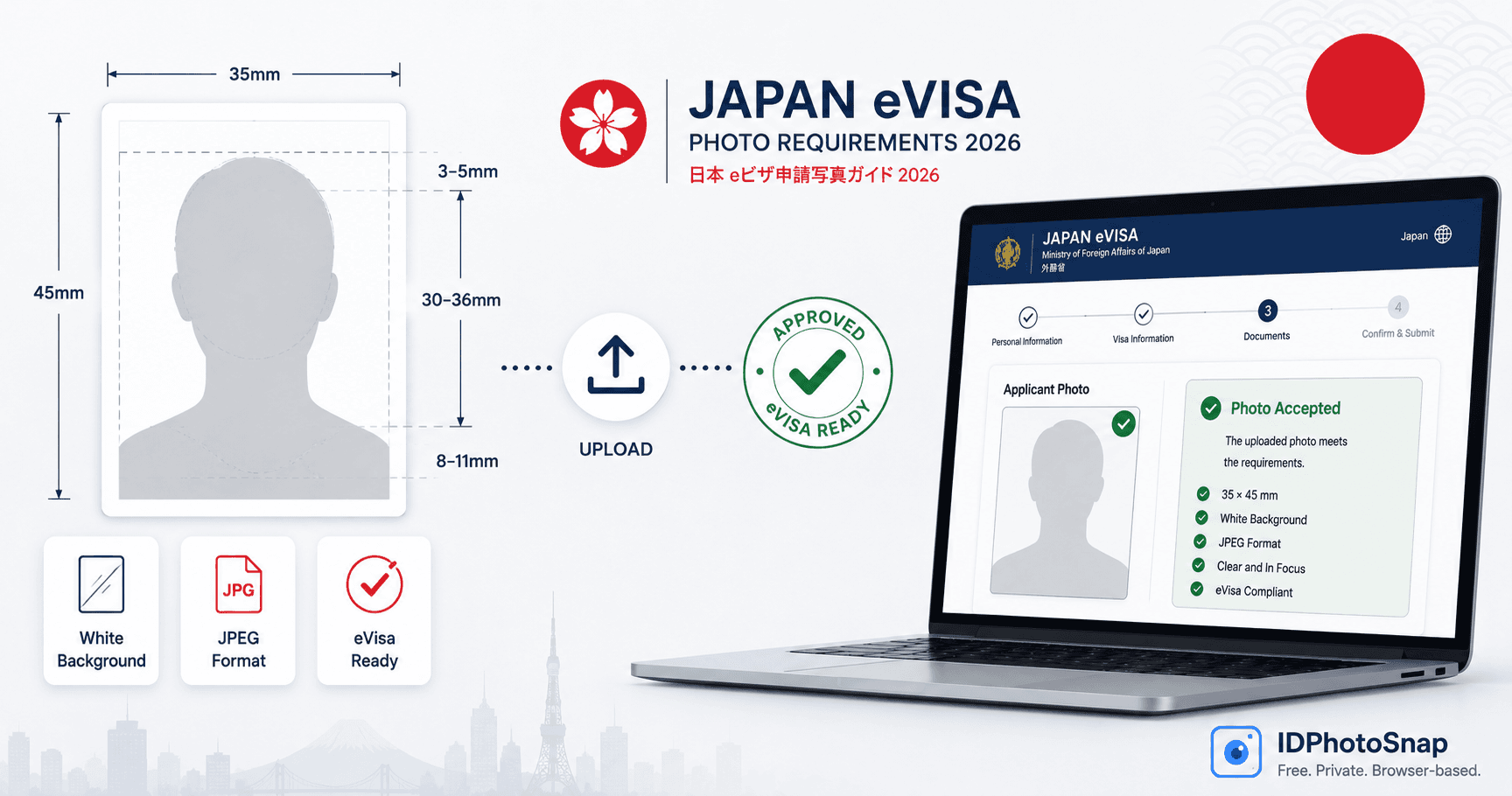
Japan rolled out its eVisa system progressively from 2023, and by 2026 the system covers tourist applicants from about 60 countries. The photo upload step has two specific quirks that catch most applicants: the photo must be a perfect 1:1 square (45x45 mm), not the 35x45 mm Schengen-style rectangle that almost every studio produces by default; and the file-size cap on the upload portal is 240 KB JPEG, similar to the US DS-160 cap.
This guide covers the actual Japan eVisa photo specification, the common rejection reasons, and the countries currently in the eVisa scope. Everything is verified against the Japan Ministry of Foreign Affairs (MOFA) eVisa portal at evisa.mofa.go.jp.
What is the Japan eVisa photo specification in 2026?
The Japan eVisa photo is 45x45 mm square (or 600x600 pixels at minimum for the digital upload). The background is plain white or off-white. The format is color JPEG, file size under 240 KB at upload. Face geometry follows ICAO 9303: head occupies 50 to 69 percent of the frame, eyes open and clearly visible, neutral expression with mouth closed, both ears visible if hair allows, no glasses, no head covering except for religious reasons.
The square aspect ratio is the key trap. Most studios in source-market countries (Philippines, Indonesia, Vietnam, India, Brazil, Saudi Arabia, Egypt) default to the 35x45 mm Schengen format, which is rejected by the Japan eVisa portal because the aspect ratio is wrong. The portal returns either a silent upload failure or a downstream reviewer rejection.
Which countries can apply for a Japan eVisa in 2026?
The eVisa scope expanded from a pilot in 2023 to approximately 60 countries by 2026. Confirmed in-scope sources (verify the current list at evisa.mofa.go.jp before applying):
- Asia: Philippines, Indonesia, Vietnam, India, Cambodia, Laos, Myanmar, Bangladesh, Sri Lanka, Mongolia
- Middle East: UAE, Saudi Arabia, Egypt, Jordan, Lebanon
- Africa: South Africa (limited categories), Morocco, Tunisia
- Americas: Brazil, Colombia, Peru, Argentina
- Eastern Europe: Ukraine (some categories), Belarus, Kazakhstan
Citizens of Schengen, the US, UK, Canada, Australia, New Zealand, Singapore, Hong Kong, Taiwan, and a few other historically visa-exempt countries do not need the eVisa for short tourist stays. They may still need it for business visa, work visa, or specific category applications.
What are the most common Japan eVisa photo rejection reasons in 2026?
- Photo not 1:1 square aspect ratio (most studios produce 35x45 mm by default).
- File size over 240 KB at upload (silent failure).
- Background not plain white (light grey, off-white with tint, or any pattern fails).
- Shadow on the background from side lighting.
- Head tilt or off-center face crop.
- Glasses reflection or glare obscuring eyes.
- Smile or visible teeth (neutral expression required).
- Low resolution that pixelates when displayed at the portal print size.
- AI face editing applied (skin smoothing, beauty filters - prohibited under the 2026 digital authenticity rule that Japan implemented in alignment with the US and EU).
- Photo older than 6 months at submission date.
For a full diagnostic on rejection reasons across all portals, see our top 10 rejection reasons guide.
How does the IDPhotoSnap Japan eVisa workflow look?
Take a photo on your phone against a plain white wall with daylight in front of you. Upload to IDPhotoSnap and pick Japan eVisa. The tool will:
- Crop to the 45x45 mm square spec (1:1 aspect ratio).
- Replace the background with pure white as required.
- Iteratively compress JPEG quality until the file is under 240 KB while preserving facial detail.
- Export the portal-sized JPEG ready for evisa.mofa.go.jp upload, plus a print-ready PDF if you need a physical copy at the embassy.
The photo never leaves your device. Processing runs in your browser via WebAssembly. No signup, no watermark, free. Open the Japan photo tool.
Will JESTA replace the eVisa, and what about its photo spec?
Japan announced JESTA (Japan Electronic System for Travel Authorization) for 2030 rollout. JESTA is modeled on the US ESTA and the EU ETIAS: a pre-screening system for visa-exempt travelers, charged on a per-trip basis. As of 2026 JESTA is not active. Visa-exempt visitors travel without pre-registration; visa-required applicants use the eVisa or paper visa.
When JESTA launches, expect the same 45x45 mm white-background 240 KB JPEG photo standard to apply, since Japan has standardized this format across all of its biometric document workflows.See our ETIAS guide for the EU equivalent and the broader trend of pre-screening systems across major economies.
Frequently asked questions
What is the photo size for a Japan eVisa in 2026?
The Japan eVisa photo size is 45x45 mm square (or 600x600 pixels at minimum for digital upload), white or off-white background, color JPEG. The same square format applies to the JESTA pre-registration system (when active) and to consular paper applications. Files for the Japan eVisa portal are capped at 240 KB JPEG, similar to the US DS-160 cap.
How do I take a Japan eVisa photo that passes first time?
Use any phone camera against a plain white wall with daylight in front of you (not behind). Face the camera directly with shoulders square, neutral expression, mouth closed. Remove glasses, hats, and any head covering not required for religious reasons. Crop to a perfect square (45x45 mm or 1:1 aspect ratio). Compress the JPEG to under 240 KB while preserving facial detail. Eyes open, both ears visible if hair allows.
What are the most common Japan eVisa photo rejections?
In order of frequency observed: photo not square (most studios produce 35x45 mm Schengen format by default, not 45x45 mm Japan), file size over 240 KB, shadow on the background from side lighting, head tilt or off-center face, glasses reflection, smile or teeth showing, low resolution that pixelates at portal display size, AI face editing (skin smoothing or beauty filters - prohibited under the 2026 digital authenticity rule that applies in Japan as well as the US and EU), and photo older than 6 months.
Who needs a Japan eVisa in 2026?
Citizens of approximately 60 countries who are not currently visa-exempt for Japan tourist entry. The eVisa was rolled out progressively from 2023 and as of 2026 covers most tourist applicants from Brazil, the Philippines, Indonesia, Vietnam, India, Cambodia, the UAE, Saudi Arabia, Egypt, and others. Citizens of Schengen, the US, UK, Canada, Australia, and other historically visa-exempt countries do not need the eVisa for short tourist stays but may need it for specific business or work purposes.
Can I use the same photo for Japan eVisa and Japan passport?
No. The Japan eVisa photo is 45x45 mm square (white background, 240 KB cap). The Japanese citizen passport photo (for Japanese nationals applying for or renewing their passport) is 35x45 mm rectangular with the same white background. The aspect ratios are different. Foreign applicants for Japan tourist or business eVisa always use the 45x45 mm square format; Japanese passport holders use 35x45 mm.
Is the JESTA system mandatory in 2026?
JESTA (Japan Electronic System for Travel Authorization) is the pre-screening system Japan has announced for 2030 rollout, modeled on the US ESTA and EU ETIAS. As of 2026 JESTA is not mandatory; tourist applicants either travel visa-free under existing bilateral arrangements or apply for the standard eVisa or paper visa. The eVisa photo spec (45x45 mm white background, 240 KB JPEG) will likely carry over to JESTA when it launches.
Related guides
Saudi Arabia Visa Photo 2026: Enjaz 200 KB Cap Explained
Saudi Arabia visa photo spec for 2026: 35x45 mm, white background, 200 KB Enjaz portal cap. Why studio photos silently fail, origin-specific notes for India, Pakistan, Bangladesh, Indonesia, Nepal, Philippines.
Why Was My Passport Photo Rejected? Top 10 Reasons (2026)
Most passport photo rejections come down to 10 specific issues. Each one is fixable in 2 minutes. Here's the full diagnostic checklist with examples.
Are AI Passport Photos Banned in 2026? (Fact-Check)
Content farms claim a new AI passport photo ban in 2026. Fact-check: no new rule. What State Dept actually prohibits and allows.
ETIAS 2026: Do You Need a Passport Photo for Europe?
ETIAS launches late 2026 for visitors from 60+ visa-exempt countries. Short answer: no separate photo upload. What it does need.
About the Author
Elena Dev, Founder of IDPhotoSnap
Elena Dev is the sole operator of IDPhotoSnap. Her work involves auditing the official photo specifications of 100+ countries against issuing-authority sources (embassies, government portals, ICAO 9303) and translating those rules into a browser-only tool that runs entirely on the user's device. The full 276-format specification dataset is published as MIT open data on GitHub. Source verification methodology and corrections policy are documented on the editorial standards page. Every article is written and reviewed by Elena Dev. Corrections: elena@idphotosnap.com.
Found this useful? Public reviews are how new readers discover IDPhotoSnap. Leave a quick Trustpilot review →