UAE Emirates ID and Residence Visa Photo 2026 (43x55 mm)
By Elena Dev, Founder · June 10, 2026 · 9 min read
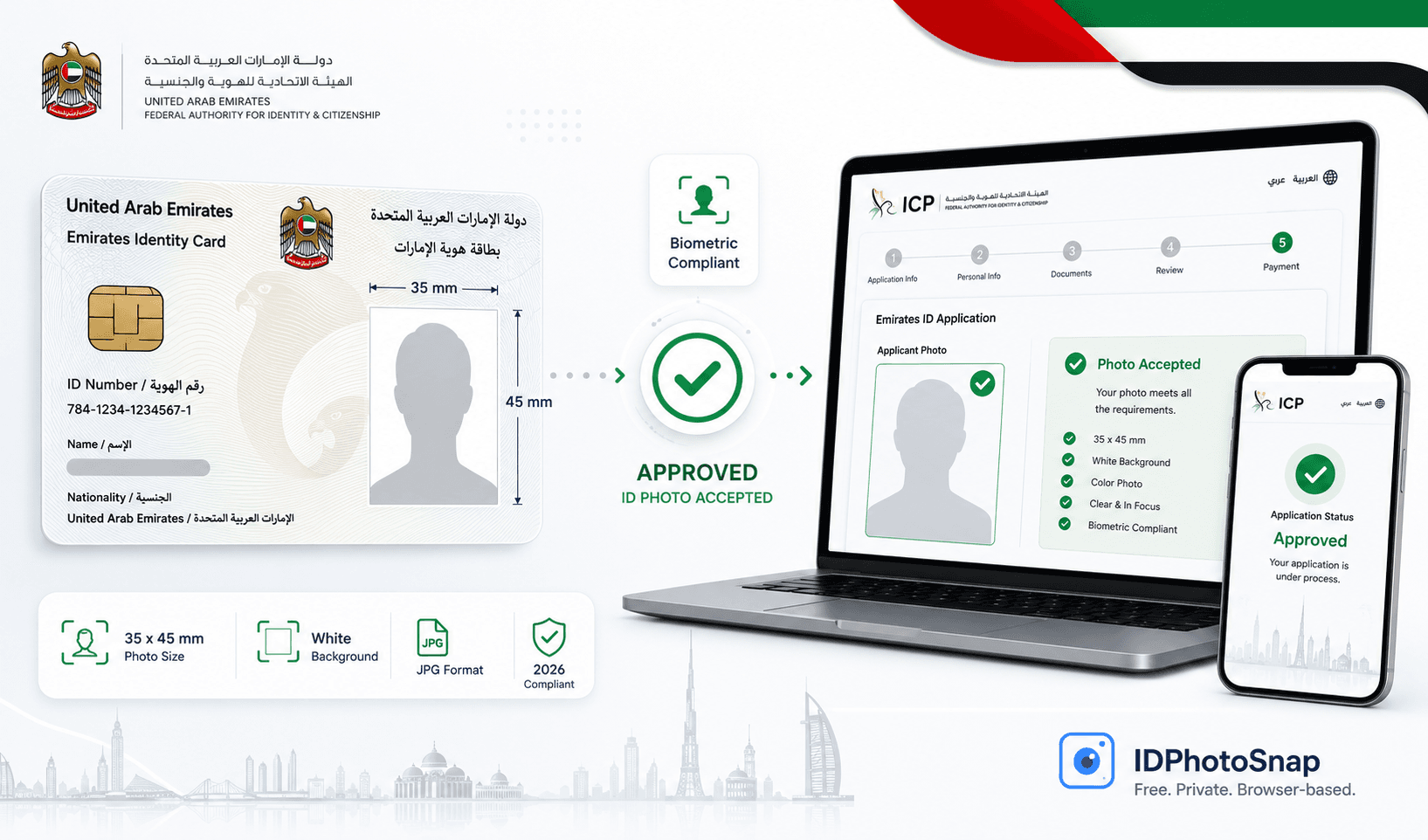
The UAE Emirates ID and residence visa photo specification is 43x55 mm with a white background - larger than the standard 35x45 mm work visa photo, larger than the Schengen format, larger than most studio defaults. Submitting the wrong size is the single most common rejection reason at Tasheel and Amer typing centers in Dubai and Abu Dhabi.
This guide covers the exact 2026 UAE photo specifications for Emirates ID, residence visa, work visa, and tourist visa, the four portals you may need to upload to, and the origin-specific issues that affect applicants from India, Pakistan, the Philippines, and Bangladesh (the four largest source countries for UAE expat residency).
What is the UAE photo spec for each visa category in 2026?
| Category | Size | Background | Portal |
|---|---|---|---|
| Emirates ID | 43x55 mm | White | ICP |
| Residence visa | 43x55 mm | White | ICP / GDRFA |
| Work visa (private sector) | 35x45 mm | White | Tasheel |
| Tourist visa (Dubai) | 35x45 mm | White | Amer / Smart Dubai |
| Family sponsorship | 43x55 mm | White | ICP / GDRFA |
File format is color JPEG. File size cap is typically under 500 KB across all four portals, less strict than the Saudi Enjaz 200 KB cap. Face must occupy 50 to 69 percent of the frame, neutral expression, mouth closed, eyes open, no glasses, taken within the last 6 months.
Which portal do I use for UAE Emirates ID and visa applications?
- ICP (Federal Authority for Identity): Emirates ID applications, residence visa renewals across all seven emirates, family sponsorship. Web portal at icp.gov.ae, mobile app ICP UAE, kiosks at malls and typing centers. The de facto canonical portal for residence and Emirates ID.
- GDRFA (Dubai): emirate-specific visa categories for Dubai residents - long-term visa types (Golden Visa, Green Visa), Dubai-only categories.
- Tasheel: Labour visa for private-sector workers across all emirates. Typing centers handle applications on behalf of employers.
- Amer / Smart Dubai: Tourist visa applications for Dubai. Other emirates have their own tourist portals (Abu Dhabi via TAMM, Sharjah via SBDE).
Why is the 43x55 mm size different from the work visa size?
The Emirates ID card and residence permit stamp use a larger printed photo cell than the standard work visa stamp. ICP and GDRFA standardized the photo input at 43x55 mm to match the print output without further scaling. The work visa stamp uses the 35x45 mm Schengen format that legacy Tasheel systems were designed around.
Practical consequence: studios in source countries (Mumbai, Karachi, Manila, Dhaka) default to the 35x45 mm format because it is the most common visa size globally. Applicants submit that to ICP or the typing center for Emirates ID, and the application is rejected for size mismatch. The applicant pays again at the typing center for a 43x55 mm reprint, plus loses a day.
Origin-specific notes (India, Pakistan, Philippines, Bangladesh)
These four countries account for the majority of UAE expat residency applications:
- India:Studios in Mumbai, Delhi, Kerala, Hyderabad default to 35x45 mm. Always ask specifically for "UAE Emirates ID size 43x55 mm". Indian applicants comprise approximately 30 percent of UAE expat residency stock.
- Pakistan:Karachi, Lahore, Islamabad studios same default. Specify "UAE residence size 43x55 mm" or do the crop at home.
- Philippines: Manila studios increasingly aware of UAE specs because POEA flow has standardized over the last 5 years. Still worth verifying explicitly.
- Bangladesh: Dhaka studios produce 35x45 mm or 45x55 mm depending on the studio; UAE needs 43x55 mm specifically. BMET clearance does not pre-validate UAE photo specs.
For applicants traveling between Saudi work and UAE residence in the same year, both photos can be made from the same source phone photo with different crops. See our Saudi Arabia Enjaz visa photo guide for the Saudi 35x45 mm 200 KB workflow.
How does the IDPhotoSnap UAE workflow look?
Take a photo on your phone against a plain white wall with daylight in front of you. Upload to IDPhotoSnap and pick UAE Emirates ID or UAE work visa. The tool will:
- Crop to the exact spec (43x55 mm for Emirates ID and residence, 35x45 mm for work visa).
- Replace the background with pure white as required.
- Compress JPEG to under 500 KB while preserving facial detail.
- Export the portal-sized JPEG for ICP/GDRFA/Tasheel/Amer upload, plus a print-ready PDF for the typing center if needed.
The photo never leaves your device; processing runs in your browser via WebAssembly. No signup, no watermark, free. Open the photo tool. Most UAE visa applicants apply from one country: see the dedicated guides for UAE visa photo from India and from Pakistan, which cover the ICP and GDRFA upload format and the emigration-clearance step for workers.
Frequently asked questions
What is the photo size for a UAE residence visa and Emirates ID in 2026?
The UAE residence visa photo is 43x55 mm with a white background, slightly larger than the work-visa photo at 35x45 mm. The Emirates ID photo uses the same 43x55 mm specification. Both must be color JPEG, face occupying 50 to 69 percent of the frame, neutral expression, mouth closed, eyes open, no glasses, taken within the last 6 months.
Why is the UAE residence visa photo size different from the work visa?
UAE General Directorate of Residency and Foreigners Affairs (GDRFA) and the Federal Authority for Identity, Citizenship, Customs and Port Security (ICP) standardized the residence visa and Emirates ID at the larger 43x55 mm format because the printed Emirates ID card uses a larger photo cell than the standard work visa stamp. Applicants who submit a 35x45 mm work-visa-format photo for an Emirates ID application get rejected at the typing center stage.
Where do I upload the UAE residence visa photo - Tasheel, Amer, ICP, or GDRFA?
Multiple portals handle different categories. Tasheel is the labour visa portal for private-sector workers; Amer handles tourist visas in Dubai; ICP handles federal Emirates ID and residence renewals; GDRFA handles emirate-specific visa categories. Photo uploads on all four portals use the same 43x55 mm specification for residence and Emirates ID, and 35x45 mm for work visa categories. The file is typically JPEG under 500 KB, looser than the strict Saudi 200 KB Enjaz cap.
Can I use the same photo for Emirates ID and UAE residence visa renewal?
Yes. Both use the same 43x55 mm white-background spec. The same source photo can be uploaded across the Emirates ID application and the residence visa renewal, provided the photo is within the 6-month freshness window at each submission. If you applied for an Emirates ID 8 months ago and now need a residence renewal, take a fresh photo since the original is outside the freshness window.
What are the most common UAE Emirates ID and residence visa photo rejections?
In order of frequency: photo size 35x45 mm (work visa format) submitted for an Emirates ID or residence application requiring 43x55 mm; background not plain white; shadow on the background; head tilt or off-center crop; glasses or reflection; smile showing teeth; AI face editing prohibited under the 2026 digital authenticity rules that apply in the UAE same as the US and EU; photo over 6 months old at submission; head covering improperly positioned (for women wearing hijab, the face must be fully visible from forehead to chin with no shadow from the covering).
Origin-specific notes for India, Pakistan, Philippines, Bangladesh expat workers?
These four countries account for the majority of UAE expat residency applications. Common issues: studio photos in Mumbai, Karachi, Manila, and Dhaka default to the 35x45 mm Schengen format, which is wrong for UAE Emirates ID (needs 43x55 mm). Always ask the studio specifically for UAE residence size 43x55 mm. Tasheel typing centers in Dubai and Abu Dhabi often reject incoming applications for size mismatch on the first attempt. Better to crop at home with a tool that knows the spec before paying for studio prints.
Related guides
Saudi Arabia Visa Photo 2026: Enjaz 200 KB Cap Explained
Saudi Arabia visa photo spec for 2026: 35x45 mm, white background, 200 KB Enjaz portal cap. Why studio photos silently fail, origin-specific notes for India, Pakistan, Bangladesh, Indonesia, Nepal, Philippines.
Why Was My Passport Photo Rejected? Top 10 Reasons (2026)
Most passport photo rejections come down to 10 specific issues. Each one is fixable in 2 minutes. Here's the full diagnostic checklist with examples.
Are AI Passport Photos Banned in 2026? (Fact-Check)
Content farms claim a new AI passport photo ban in 2026. Fact-check: no new rule. What State Dept actually prohibits and allows.
US Passport Photo Requirements 2026 (Complete Guide)
Every official US passport photo requirement for 2026: size, background, head size, expression, and State Department specifications.
About the Author
Elena Dev, Founder of IDPhotoSnap
Elena Dev is the sole operator of IDPhotoSnap. Her work involves auditing the official photo specifications of 100+ countries against issuing-authority sources (embassies, government portals, ICAO 9303) and translating those rules into a browser-only tool that runs entirely on the user's device. The full 276-format specification dataset is published as MIT open data on GitHub. Source verification methodology and corrections policy are documented on the editorial standards page. Every article is written and reviewed by Elena Dev. Corrections: elena@idphotosnap.com.
Found this useful? Public reviews are how new readers discover IDPhotoSnap. Leave a quick Trustpilot review →