Unified GCC Visa (GCC Grand Tours) 2026: One Photo for 6 Gulf Countries
By Elena Dev, Founder · June 16, 2026 · 8 min read
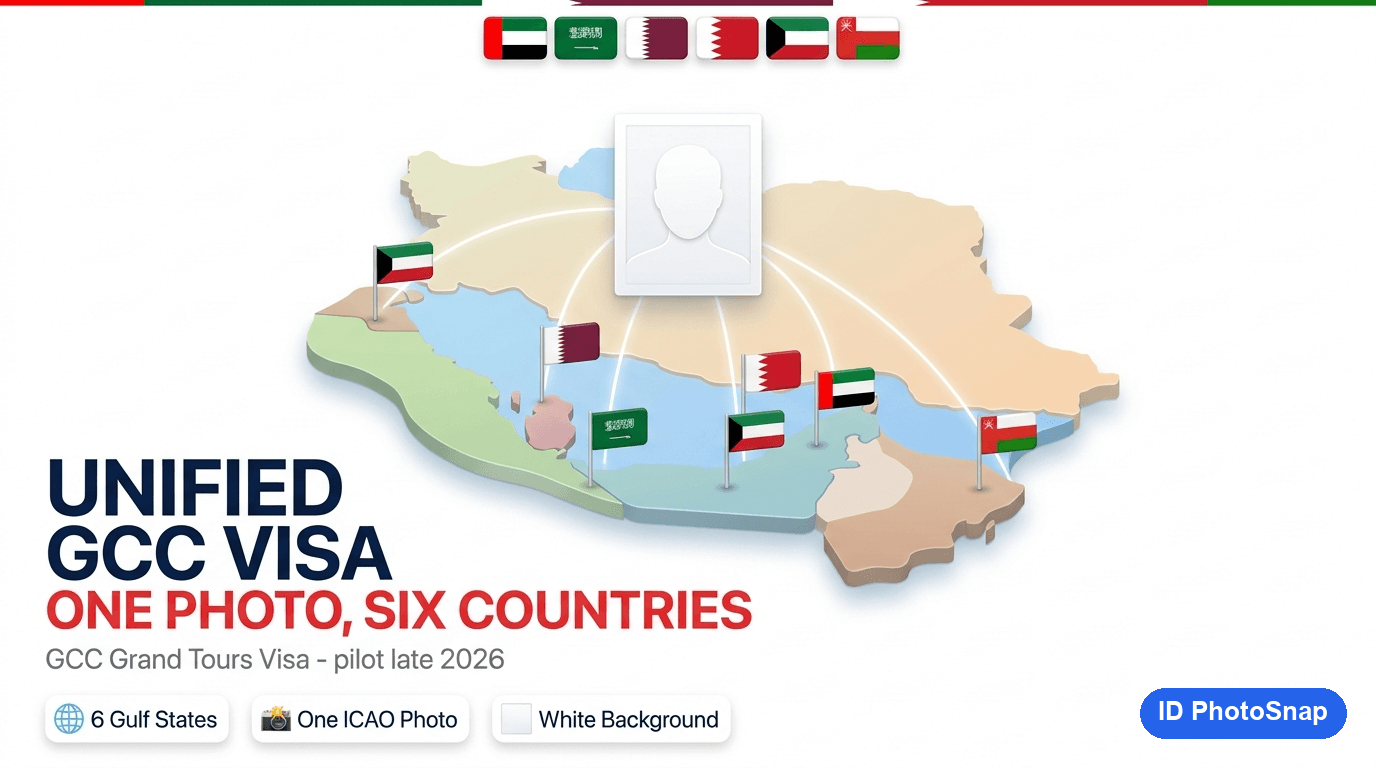
The Gulf is about to get its own version of the Schengen visa. The GCC Grand Tours Visa, a single application that covers the UAE, Saudi Arabia, Qatar, Bahrain, Kuwait, and Oman, is set for a pilot launch in late 2026. One visa, six countries, up to 90 days of multi-entry travel. The natural question for anyone planning ahead is simple: what photo will it need?
The short answer is reassuring. There is no strange new format. All six member states already build their visa photos on the same ICAO 9303 biometric base: a recent colour photo on a plain white background with the face clearly visible. A photo that is shot cleanly for that base today is the right thing to prepare for the unified visa tomorrow.
What the GCC Grand Tours Visa actually is
The six Gulf Cooperation Council states have finished the technical roadmap for a single-window application platform that grants visitors multi-entry access across the bloc for up to 90 days. The pilot phase is confirmed for the fourth quarter of 2026, starting with a UAE to Bahrain corridor, while immigration databases and security screening are integrated across the six sovereign states. A full six-country rollout is expected in late 2026 or early 2027 once the pilot succeeds. The application will be entirely online.
The photo standard, in plain terms
Guidance published so far asks for a recent colour passport-style photo, taken within the last 6 months, on a plain white background, clearly identifiable as you, meeting the biometric specification each member already enforces. In practice that means:
- Plain pure white background, no shadow, no pattern, no object in frame.
- Face centred and filling most of the frame, neutral expression, mouth closed.
- Both eyes open and visible, no glasses, no head covering except for religious reasons (face fully visible).
- Recent: taken within the last 6 months.
Until then: the per-country sizes still differ
While the unified visa is being piloted, each country keeps its own millimetre size for individual visas. They share the white-background ICAO base, so one well-shot source photo can be cropped to each:
| Country | Visa photo size | Portal / note |
|---|---|---|
| Saudi Arabia | 35 x 45 mm | Enjaz, strict 200 KB cap |
| UAE | 43 x 55 mm | ICP / GDRFA |
| Qatar | 30 x 40 mm | MOI / Metrash2, under 2 MB |
| Bahrain | ~40 x 60 mm | eVisa, white background |
| Oman | ~43 x 55 mm | eVisa, white background |
| Kuwait | white background, ICAO | MOI eVisa |
For the dedicated corridor guides from India, see Saudi visa photo from India, UAE visa photo from India, and Qatar visa photo from India. From Pakistan, see Saudi, UAE, and Qatar visa photo from Pakistan.
How to prepare one photo for the whole Gulf
The smart move is to capture one clean source photo on a pure white background and crop it to whatever each portal needs, rather than paying a studio for each country. Stand facing a window with a plain white wall behind you, neutral expression, no glasses, and take the photo with the rear camera. Then crop to size and set a true white background. A free browser tool such as IDPhotoSnap does the crop and background for any Gulf size, exports a portal-ready JPEG, and keeps the photo on your device. When the unified GCC visa goes live, the same white-background photo is what its single application will ask for.
Frequently asked questions
What is the GCC Grand Tours unified visa?
The GCC Grand Tours Visa is a single, Schengen-style tourist visa that will let visitors travel across all six Gulf Cooperation Council states (the UAE, Saudi Arabia, Qatar, Bahrain, Kuwait, and Oman) on one online application, with multi-entry access for up to 90 days. A pilot launch is set for late 2026, starting with a UAE to Bahrain corridor, with a full rollout expected in late 2026 or early 2027.
What photo will the unified GCC visa require?
Official guidance so far calls for a recent colour passport-style photo on a plain white background, taken within the last 6 months, meeting the ICAO 9303 biometric standard that all six member states already use. There is no exotic new format. A photo on a plain white background with the face clearly visible, neutral expression, no glasses, is the safe baseline to prepare.
Can I use one photo for all six Gulf countries?
Until the unified visa is fully live, each country still has its own millimetre size for individual visas: Saudi Arabia 35x45 mm (Enjaz, 200 KB cap), the UAE 43x55 mm (ICP/GDRFA), Qatar 30x40 mm (MOI/Metrash2), Bahrain and Oman around 40x60 and 43x55 mm. They all share the same white-background ICAO base, so one well-shot white-background source photo can be cropped to each size. For the unified GCC visa itself, a single white-background biometric photo is expected to cover the whole bloc.
When does the GCC unified visa launch?
A pilot phase is confirmed for late 2026 (Q4), beginning with a UAE to Bahrain travel corridor while immigration databases and security screening are integrated across the six states. A full six-country rollout is expected in late 2026 or early 2027 once the pilot succeeds.
Related guides
Saudi Arabia Visa Photo 2026: Enjaz 200 KB Cap Explained
Saudi Arabia visa photo spec for 2026: 35x45 mm, white background, 200 KB Enjaz portal cap. Why studio photos silently fail, origin-specific notes for India, Pakistan, Bangladesh, Indonesia, Nepal, Philippines.
UAE Emirates ID and Residence Visa Photo 2026 (43x55 mm)
UAE Emirates ID and residence visa photo spec for 2026: 43x55 mm white background, larger than work-visa 35x45 mm. ICP/GDRFA/Tasheel/Amer portals, origin notes for India/Pakistan/PHL/Bangladesh expats.
Japan eVisa Photo 2026 (45x45 mm Square, 240 KB Cap)
Japan eVisa photo spec for 2026: 45x45 mm square (1:1 aspect ratio), white background, 240 KB JPEG cap. Why studios default to wrong size, common rejections, in-scope countries.
Schengen Visa Photo Specifications 2026 (Complete 27-Country Guide)
Schengen visa photo spec for 2026: 35x45 mm, light grey or off-white background, Annex 11 + ICAO 9303 compliant. VFS Global / BLS / TLS Contact file caps, 2026 EES changes, common rejection reasons.
About the Author
Elena Dev, Founder of IDPhotoSnap
Elena Dev is the sole operator of IDPhotoSnap. Her work involves auditing the official photo specifications of 100+ countries against issuing-authority sources (embassies, government portals, ICAO 9303) and translating those rules into a browser-only tool that runs entirely on the user's device. The full 276-format specification dataset is published as MIT open data on GitHub. Source verification methodology and corrections policy are documented on the editorial standards page. Every article is written and reviewed by Elena Dev. Corrections: elena@idphotosnap.com.
Found this useful? Public reviews are how new readers discover IDPhotoSnap. Leave a quick Trustpilot review →