Schengen Visa Photo Specifications 2026 (Complete 27-Country Guide)
By Elena Dev, Founder · June 11, 2026 · 9 min read
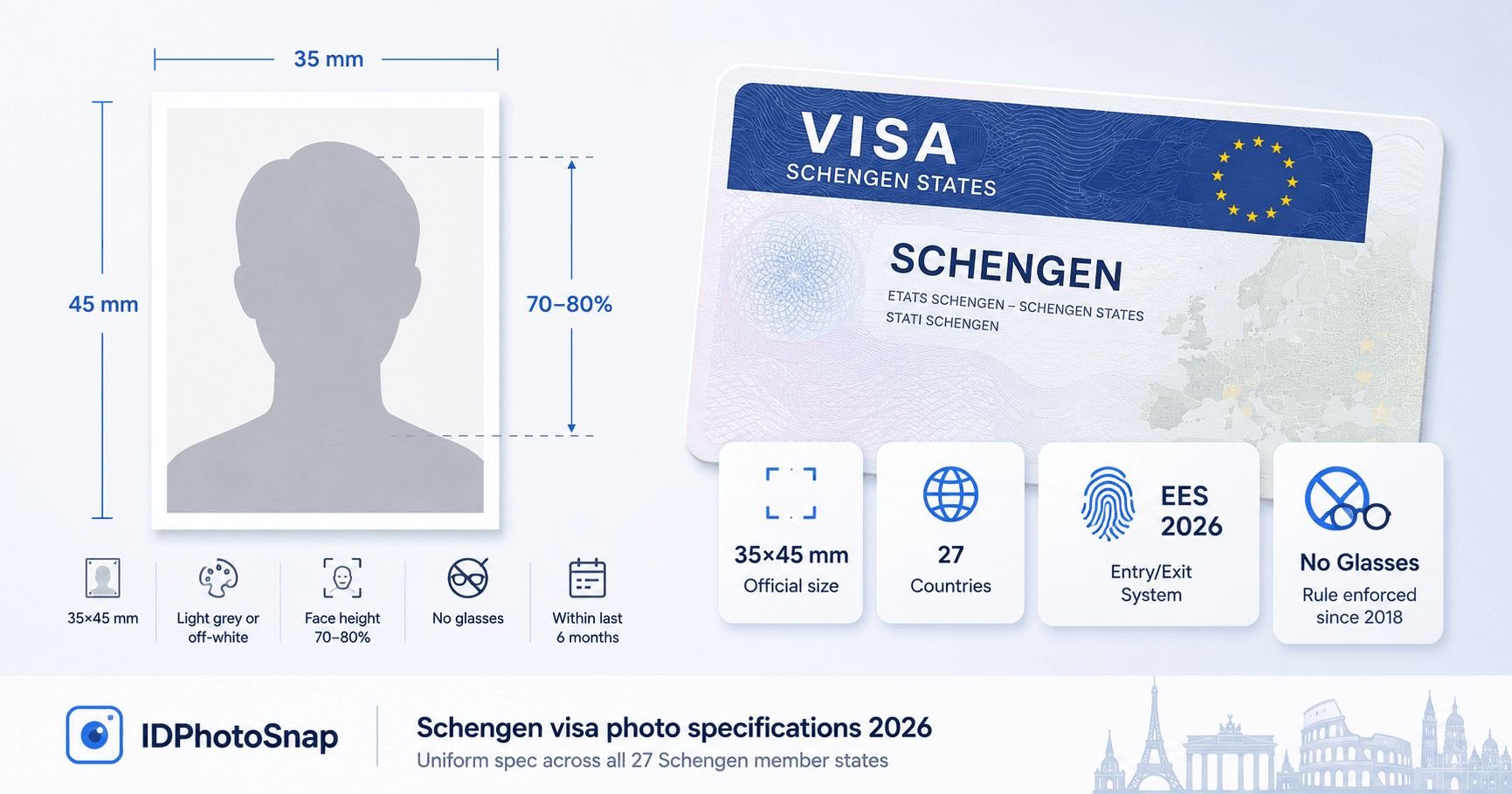
The Schengen visa photo specification is uniform across all 27 member states: 35x45 mm, light grey or off-white background, defined by Annex 11 of the Schengen Acquis and aligned with ICAO 9303 biometric standards. The same photo works for an application at a German consulate, a Spanish consulate, or an Italian one. The challenge is not the spec itself but the consistency between what the spec says and what local studios produce.
This guide is the dedicated reference for the Schengen visa photo: every requirement in one place, per-country quirks where they exist, file-size caps across VFS Global / BLS / TLS Contact, and the 2026 changes from EES and the upcoming ETIAS. Everything verified against EU Regulation 810/2009 (Schengen Visa Code) and the application center documentation.
Watch: the Schengen visa photo spec explained in 2 minutes
What is the official Schengen visa photo specification in 2026?
| Parameter | Specification |
|---|---|
| Size | 35x45 mm |
| Background | Light grey or off-white (plain white universally accepted in practice) |
| Face height | 70 to 80 percent of frame (chin to crown) |
| Expression | Neutral, mouth closed |
| Eyes | Open, clearly visible, looking straight ahead |
| Glasses | Not allowed (rule enforced since 2018) |
| Head covering | Only for religious reasons; face fully visible |
| Format | Color JPEG |
| File size | No uniform cap; safe range 250 to 500 KB |
| Resolution | 600x600 to 1200x1200 px minimum |
| Age | Taken within last 6 months |
How do the 27 Schengen states differ on photo handling in 2026?
The visa photo spec is uniform. The submission infrastructure differs:
- VFS Global: primary application-center operator for around 17 member states (Germany, France, Italy, Spain, Netherlands, Belgium, Austria, Sweden, Denmark, Finland, Norway, Czech Republic, Poland, Hungary, Slovenia, Greece, Portugal). Photo upload caps typically 250 KB to 1 MB JPEG.
- BLS International: handles Spanish, Italian, and a few other consulates in specific markets (India, Sri Lanka, certain African countries).
- TLS Contact: primary application center for French, Swiss (Schengen since 2008), Belgian, and selected other consulates. Photo upload caps usually 500 KB to 1 MB.
- Direct consulate submission: in some countries the consulate accepts walk-in applications without an intermediary. Photo specs are identical.
For Indian applicants specifically, see our 5-year Schengen cascade rule guide which explains how the 2-year then 5-year multi-entry path works after 2 prior Schengen visas.
What are the most common Schengen visa photo rejections in 2026?
- Glasses (rule enforced since 2018, still the single most common rejection).
- Background not light grey or off-white (studios producing pure white sometimes fail at strict consulates, although pure white is usually accepted).
- Smile or visible teeth.
- Head tilt or off-center face crop.
- Photo older than 6 months at submission.
- Shadow on the background from side lighting.
- Glasses reflection from a recent photo where the applicant only later removed glasses.
- AI face editing applied (skin smoothing, beauty filters - prohibited under the 2026 EU digital authenticity rules that mirror the US Department of State 2026 rules).
- Low resolution that pixelates at portal display size.
- Religious head covering improperly positioned (face must be fully visible from forehead to chin with no shadow from the covering).
For a complete diagnostic of photo rejection reasons across all portals, see our top 10 rejection reasons guide.
How does EES change the Schengen visa workflow in 2026?
The EU Entry/Exit System (EES) launched 10 April 2026 at all Schengen external borders. EES captures biometric data (face and fingerprints) at the kiosk on arrival, replacing the manual passport stamping that has been in place for decades. EES does not change the visa photo specification at the application stage. The 35x45 mm spec, the background, the file format remain identical.
What EES does change: applicants going through a Schengen border for the first time after April 2026 must do a one-time biometric enrollment at the kiosk on arrival. This typically adds 5 to 15 minutes to the first border crossing. Subsequent crossings within the same passport are matched against the enrollment automatically.
For visa-exempt visitors, the upcoming ETIAS pre-screening system (late 2026 rollout) adds a separate pre-trip authorization, but no separate photo upload - ETIAS uses the existing passport biometric data. See our ETIAS guide for the visa-exempt traveler flow.
How does the IDPhotoSnap Schengen workflow look?
Take a photo on your phone against a plain white wall with daylight in front of you. Upload to IDPhotoSnap and pick Schengen visa. The tool will:
- Crop to the 35x45 mm Schengen spec with the correct 70 to 80 percent face height.
- Replace the background with the required color (light grey for strict-consulate paths, or pure white for the universally accepted default).
- Compress JPEG to 250 to 500 KB while preserving facial detail and ICAO 9303 compliance.
- Export the portal-sized JPEG ready for VFS Global, BLS International, TLS Contact, or direct consulate upload, plus a print-ready PDF for in-person interview.
The photo never leaves your device; processing runs in your browser via WebAssembly. No signup, no watermark, free. Open the Schengen photo tool.
Frequently asked questions
What is the Schengen visa photo size in 2026?
The Schengen visa photo size is 35x45 mm, color JPEG, plain light grey or off-white background, head occupying 70 to 80 percent of the frame from chin to crown, neutral expression with mouth closed, both eyes open and clearly visible, no glasses, no head covering except for religious reasons, taken within the last 6 months. The specification is defined by Annex 11 of the Schengen Acquis and aligns with ICAO 9303 biometric standards. The same spec applies at all 27 Schengen consulates.
Is the Schengen photo size really the same across all 27 countries?
Yes for visa photos. All 27 Schengen states (Austria, Belgium, Bulgaria, Croatia, Cyprus, Czech Republic, Denmark, Estonia, Finland, France, Germany, Greece, Hungary, Iceland, Italy, Latvia, Liechtenstein, Lithuania, Luxembourg, Malta, Netherlands, Norway, Poland, Portugal, Romania, Slovakia, Slovenia, Spain, Sweden, Switzerland) accept the same 35x45 mm specification for the visa photo. Member-state passports use different sizes (Germany 35x45 mm, Italy 35x45 mm, France 35x45 mm, Sweden 35x45 mm, Spain 26x32 mm for the DNI). The Schengen visa is uniform; member-state passports are not.
What is the background color for a Schengen visa photo?
Annex 11 allows two background colors: light grey or off-white. Plain white is universally accepted in practice across all 27 consulates. Some member states have a preference (Germany and Austria prefer light grey, France and Italy accept either). The safest choice is plain white, which never fails. Pure black, dark colors, or any pattern are rejected.
What is the file-size requirement for the Schengen visa photo upload?
There is no single uniform file-size cap across all 27 Schengen consulates. Most consulates submit visa applications via VFS Global, BLS International, or TLS Contact, which accept JPEG between 250 KB and 1 MB. Some consulates (notably the German, French, and Italian portals) have their own per-country upload pages with caps between 500 KB and 1 MB. The safest target is JPEG between 250 KB and 500 KB at 600x600 to 1200x1200 pixels resolution.
Are glasses allowed for a Schengen visa photo?
No. Annex 11 prohibits glasses in the visa photo. The rule is universal across all 27 member states and has been enforced strictly since 2018. Tinted lenses, frame edges covering the eyes, or any glare on the lenses all cause rejection. Religious head coverings are allowed provided the face is fully visible from forehead to chin and from ear to ear without shadow. Medical eye patches require an attached doctor letter.
Does the EES system change the Schengen visa photo requirements in 2026?
No. The EU Entry/Exit System (EES) launched 10 April 2026 captures biometric data (face and fingerprints) at the Schengen border kiosk on arrival, but it does not change the Schengen visa photo requirements at the application stage. The 35x45 mm spec, light grey or white background, and all other Annex 11 rules remain identical. EES is a border-control system, not a visa-application system. For details see our ETIAS guide which covers both EES and the upcoming pre-screening for visa-exempt travelers.
Related guides
5-Year Schengen Visa for Indians: Cascade Rule (2026 Guide)
The EU cascade rule lets Indians earn 2-year then 5-year multi-entry Schengen visas after 2 prior visas in 3 years. Photo: 35x45 mm.
ETIAS 2026: Do You Need a Passport Photo for Europe?
ETIAS launches late 2026 for visitors from 60+ visa-exempt countries. Short answer: no separate photo upload. What it does need.
EES Is Live: Do You Need a New Passport Photo? (April 2026 Update)
The EU's Entry/Exit System launched on April 10, 2026. Here's what actually changed for passport and visa photos - and what didn't. Schengen visa specs, EES border biometrics, and ETIAS in plain language.
German Schengen Visa Photo 2026 (35x45 mm, Embassy)
2026 photo specs for German Schengen, work, and student visas, plus the May 2025 Buergeramt digital-only rule affecting citizens.
Italian Passport Photo Requirements 2026 (Polizia di Stato)
Italian passport photo specs 2026: 35x45 mm, plain white background, ICAO 9303 biometric compliance, Polizia di Stato standards.
About the Author
Elena Dev, Founder of IDPhotoSnap
Elena Dev is the sole operator of IDPhotoSnap. Her work involves auditing the official photo specifications of 100+ countries against issuing-authority sources (embassies, government portals, ICAO 9303) and translating those rules into a browser-only tool that runs entirely on the user's device. The full 276-format specification dataset is published as MIT open data on GitHub. Source verification methodology and corrections policy are documented on the editorial standards page. Every article is written and reviewed by Elena Dev. Corrections: elena@idphotosnap.com.
Found this useful? Public reviews are how new readers discover IDPhotoSnap. Leave a quick Trustpilot review →