USCIS Pivot May 2026: I-485 to Consular DS-260 + Visa Photo
By Elena Dev, Founder · May 28, 2026 · 8 min read
The short version
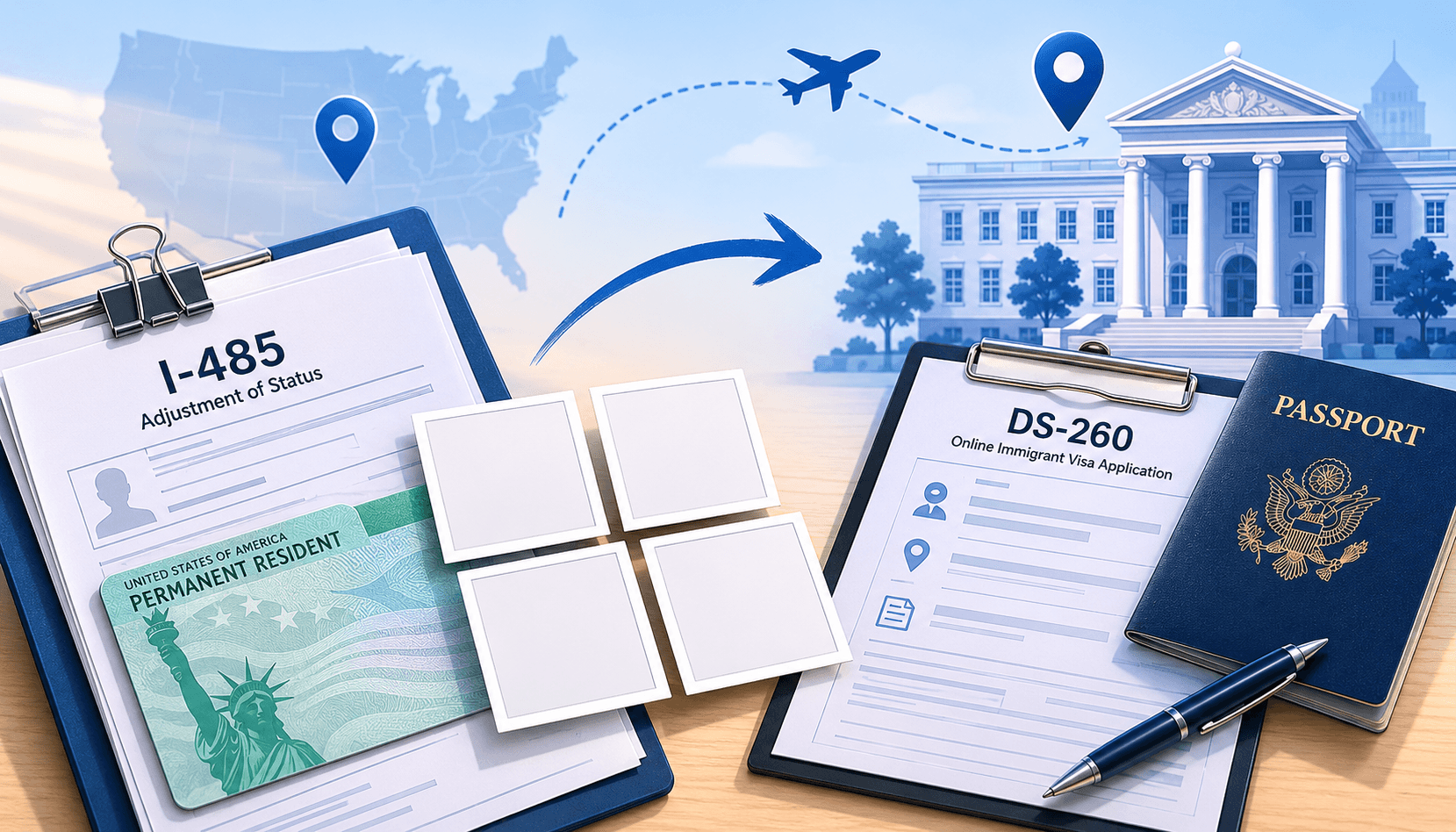
On 21-22 May 2026 USCIS issued a policy memorandum reframing Adjustment of Status (I-485) as discretionary, not a default route. Most foreign nationals seeking a US Green Card are now directed to consular processing in their home country instead - Form DS-260, interview at a US embassy / consulate, then enter the US on an immigrant visa. The visa photo requirement is the standard 2x2 inch (51x51 mm) square colour JPEG, under 240 KB for the DS-260 portal, white background, within the last 6 months. If you were planning to file I-485 inside the US, the default plan has changed - talk to your immigration attorney, and if you proceed with consular processing, you need a current US visa photo.
What changed in USCIS I-485 policy on 21-22 May 2026?
On 21 May 2026 USCIS issued a policy memorandum stating that Adjustment of Status is a Matter of Discretion and Administrative Grace, and an Extraordinary Relief that Permits Applicants to Dispense with the Ordinary Consular Visa Process. The following day, 22 May, USCIS publicly announced the operational implication: foreign nationals who want a Green Card should generally apply from outside the United States through the State Department, rather than adjusting status inside the country via Form I-485.
In plain language: the default path to a Green Card is now consular processing in the applicant's country of nationality, not I-485 filed from inside the US. I-485 remains available but is treated as discretionary relief - granted only when the applicant's circumstances are extraordinary, not routine.
This is a significant operational shift. For roughly two decades the practical norm for visa holders already in the US (H-1B, L-1, F-1 OPT, family-based, employment-based) has been to file I-485 once a priority date became current, stay in the US during processing, and avoid the consular interview. The May 22 memorandum reverses that default.
Who is affected by the USCIS consular processing pivot?
The memorandum applies broadly. Categories where the default-to-AoS practice was strongest, and therefore most disrupted:
- Employment-based applicants (EB-1, EB-2, EB-3). H-1B and L-1 holders who expected to file I-485 when their priority date became current are now directed to consular processing instead.
- F-1 OPT / STEM OPT holders. Students who completed an employer-sponsored I-140 and planned to adjust status from F-1 to permanent resident inside the US are redirected.
- Family-based applicants (FB-1 through FB-5). Spouses, parents, and children of US citizens and lawful permanent residents who were already in the US on a visa or visa waiver are redirected to consular processing in their home country.
- Diversity Visa winners (DV-2026, DV-2027). DV winners already in the US on nonimmigrant status are now expected to consular process rather than adjust status.
The memo retains USCIS discretion for "extraordinary" cases - but the bar is high and the adjudication is case-by-case. Assume consular processing applies unless an immigration attorney confirms otherwise based on the specific facts.
What does consular processing require, and what visa photo do I need?
Consular processing is the State Department path, not the USCIS path. The applicant files Form DS-260 (Online Immigrant Visa Application) with the National Visa Center, completes the form online, uploads supporting documents and a current visa photo, then attends an in-person interview at the US embassy or consulate in their country of nationality. If approved, the consular officer stamps an immigrant visa in the passport; the applicant enters the US as a lawful permanent resident on first entry.
The photo requirement is the standard US immigrant visa photo specification:
- Format: square colour JPEG, 24-bit
- Dimensions: 600x600 pixels minimum, 1200x1200 pixels maximum
- File size: 240 KB or less for the DS-260 portal upload
- Print size for the interview: 2x2 inches (51x51 mm)
- Background: plain white or off-white, no patterns, no shadows
- Head coverage: face takes up 50-69% of the image height (chin to crown)
- Expression: neutral, mouth closed, both eyes open and clearly visible
- No glasses (banned since November 2016)
- Freshness: taken within the last 6 months
- Compliance with the 2026 US State Department rule against AI-edited or digitally manipulated photos - background replacement and geometric cropping are permitted, AI facial editing is not.
This spec is identical worldwide. The photo accepted in New Delhi is the same as the photo accepted in Manila, Lagos, Jakarta, or Bangkok. Our tool generates a DS-260 portal-compliant JPEG plus a print-ready PDF with 6 photos per A4 for the interview, in under 30 seconds, free, with the photo never leaving the browser.
What does the May 2026 USCIS memo mean for applicants from India, Pakistan, Nigeria, Bangladesh, Indonesia, Vietnam?
For the six origin countries we cover with dedicated guides, each page lists the relevant US embassy / consulate locations, common rejection reasons consular officers cite for photos from that origin, and currency-specific pricing for printing.
- US visa photo from India - embassies in New Delhi, Mumbai, Chennai, Hyderabad, Kolkata. Largest origin volume.
- US visa photo from Pakistan - embassies in Islamabad, Karachi, Lahore. VFS Global processing.
- US visa photo from Nigeria - embassies in Lagos and Abuja. High rejection rates for background non-compliance.
- US visa photo from Bangladesh - embassy in Dhaka.
- US visa photo from Indonesia - embassies in Jakarta and Surabaya.
- US visa photo from Vietnam - embassies in Hanoi and Ho Chi Minh City.
What should I do if I was planning to file I-485 inside the US?
- Talk to your immigration attorney first. If you have a pending I-485, the memorandum does not automatically cancel it - adjudication shifts to discretionary review. Whether to maintain it or proactively switch to consular processing is a fact-specific decision.
- If you proceed with consular processing, prepare DS-260. The form is filed online with the National Visa Center. You upload a current digital photo (under 240 KB JPEG) and bring 1-2 printed photos to the interview. Wait times vary by post - check the State Department visa appointment wait times page for your origin.
- Generate a current visa photo. If your last visa photo is older than 6 months, you need a new one. Use our free tool for the standard 2x2 inch US visa photo - it produces both the portal-sized JPEG and a print-ready PDF in one workflow, with no upload to any server.
- Plan for the travel. Consular processing requires you to be in your country of nationality for the interview. For applicants currently in the US on a nonimmigrant visa, this means coordinating departure, the interview, and re-entry as a permanent resident.
- Account for the timeline. Consular processing can be faster or slower than I-485 depending on the post. Check State Department wait time data; expect 6-12 months at most high-volume posts.
Is the I-485 pathway closed? What this May 2026 memorandum is not
This is a policy memorandum, not a statute. Specifically:
- It does not change the underlying visa photo specification.
- It does not change priority date eligibility under the Visa Bulletin.
- It does not extinguish pending I-485 applications.
- It does not eliminate the I-485 path entirely - it reframes I-485 as discretionary rather than routine.
- It does not affect nonimmigrant visa categories or work authorisations independently.
The practical effect is that the default plan for visa holders already in the US who expected to file I-485 has changed. Whether the legal effect matches the operational shift will be tested in practice over the coming months.
If you need a US visa photo
Browser-only, photo never leaves your device, 2x2 inch JPEG sized for the DS-260 portal under 240 KB, plus a print-ready PDF with 6 photos per A4 for the interview. Free, no signup.
Open the US visa photo tool →FAQ
What did USCIS announce on 21-22 May 2026?
USCIS issued a policy memorandum stating that Adjustment of Status (I-485 filed inside the United States) is now a matter of discretion and administrative grace, not the default route. Most foreign nationals seeking a Green Card are directed instead to consular processing - leaving the US and applying through a US embassy or consulate in their home country via Form DS-260. The previous practice of routinely approving I-485 for visa holders already in the US is replaced by a discretionary review.
Does this mean I have to leave the US to get a Green Card?
Yes for most applicants, unless your case meets the extraordinary circumstances bar that USCIS retains discretion over. The default path under the new memorandum is: file DS-260 with the National Visa Center, attend an interview at a US embassy / consulate in your country of nationality, then enter the US on the immigrant visa. The carve-outs are narrow and adjudicated case by case - assume consular processing applies unless an immigration attorney confirms otherwise for your facts.
What visa photo does consular processing require?
The same 2x2 inch (51x51 mm) square colour JPEG that the US uses for every immigrant and nonimmigrant visa category. White or off-white background, head covering 50-69% of the image height, neutral expression, no glasses (banned since 2016), taken within the last 6 months. For the DS-260 portal upload the file must be JPEG between 600x600 and 1200x1200 pixels and under 240 KB. The 2026 State Department rule against digital retouching applies - background replacement and geometric cropping are permitted, AI facial editing is not.
I am an Indian H-1B holder who was about to file I-485. What now?
Under the new memorandum your default path is consular processing in India. You file DS-260 with the National Visa Center, then attend an interview at the US embassy in New Delhi or consulates in Mumbai, Chennai, Hyderabad, or Kolkata. You will need a fresh 2x2 inch visa photo for the DS-260 upload and to bring to the interview. See our origin-specific guide for embassy locations and common rejection reasons: /us-visa-photo-from-india.
Same question for Pakistani, Nigerian, Bangladeshi, Indonesian, or Vietnamese applicants?
Yes - the policy is applicant-agnostic. Your default route is consular processing at the US embassy or consulate in your country of nationality. The visa photo specification is identical worldwide (2x2 inches, 240 KB JPEG for DS-260). Origin-specific guides with embassy details, currency pricing, and common rejection reasons: /us-visa-photo-from-pakistan, /us-visa-photo-from-nigeria, /us-visa-photo-from-bangladesh, /us-visa-photo-from-indonesia, /us-visa-photo-from-vietnam.
I already filed I-485. Is it cancelled?
Pending I-485 applications are not automatically dismissed by the May 22 memorandum, but they are now adjudicated as a matter of discretion rather than entitlement. Filers should consult with their immigration attorney about whether to maintain the pending I-485 or proactively switch to consular processing. For new filers, the memo strongly suggests consular processing is the cleaner path.
Do I need a different photo for DS-260 vs the photo I already have for DS-160?
The photo specifications are identical - 2x2 inches, white background, under 240 KB for portal upload. However, the photo must be taken within the last 6 months. If your DS-160 photo is older than 6 months, you need a new one for DS-260. Our tool generates a portal-compliant JPEG plus a print-ready PDF with 6 photos per A4 in under 30 seconds, free, with no upload to any server.
Is my photo uploaded to your servers?
No. All photo processing happens locally in your browser via WebAssembly. Your photo never leaves your device - this matters for biometric documents like a US visa photo. You can verify this in any browser DevTools Network tab during the workflow: no upload requests occur. We're not a service uploading to a backend; we're a tool running entirely on the client.
Related guides
F-1 OPT Summer 2026: You Can No Longer Submit Your Own Photo (Biometrics Guide)
Starting December 12, 2025, F-1 OPT and EAD applicants can no longer submit a self-taken photo with Form I-765. USCIS will photograph you at an ASC biometrics appointment. Summer 2026 is the first full OPT cycle under this rule. Here is what every international student needs to know before filing.
DV-2027 Lottery: Passport Required at Registration (2026)
From 10 April 2026, DV-2027 Diversity Visa entrants must upload a passport scan with DS-5501. Photo spec (600x600 px JPEG) unchanged.
US Passport Photo Requirements 2026 (Complete Guide)
Every official US passport photo requirement for 2026: size, background, head size, expression, and State Department specifications.
Are AI Passport Photos Banned in 2026? (Fact-Check)
Content farms claim a new AI passport photo ban in 2026. Fact-check: no new rule. What State Dept actually prohibits and allows.
Why Was My Passport Photo Rejected? Top 10 Reasons (2026)
Most passport photo rejections come down to 10 specific issues. Each one is fixable in 2 minutes. Here's the full diagnostic checklist with examples.
iPhone Passport Photo 2026 (5-Minute Setup, Won't Get Rejected)
Take a consulate-compliant passport photo with your iPhone in 5 minutes. Lighting setup, camera settings, head positioning, and the 4 mistakes that cause 80% of rejections.
Passport Photo Size Guide: mm, Inches, Pixels (Countries)
US: 2×2 inch (51×51mm), UK: 35×45mm, Canada: 50×70mm, China: 33×48mm. Complete size reference with pixel dimensions at 300 DPI for printing.
About the Author
Elena Dev, Founder of IDPhotoSnap
Elena Dev is the sole operator of IDPhotoSnap. Her work involves auditing the official photo specifications of 100+ countries against issuing-authority sources (embassies, government portals, ICAO 9303) and translating those rules into a browser-only tool that runs entirely on the user's device. The full 276-format specification dataset is published as MIT open data on GitHub. Source verification methodology and corrections policy are documented on the editorial standards page. Every article is written and reviewed by Elena Dev. Corrections: elena@idphotosnap.com.
Found this useful? Public reviews are how new readers discover IDPhotoSnap. Leave a quick Trustpilot review →